
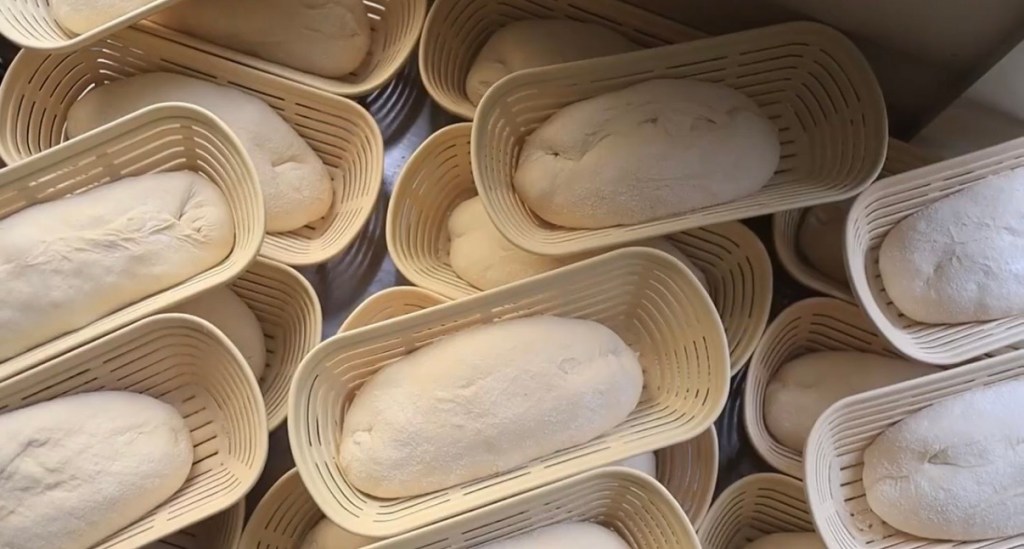
THE CRAFT · Choosing equipment for the dough you actually make
A proving basket should be chosen for the loaf, not the photograph. A beautiful oval banneton is little use if your usual dough portion is too large for it—or if the shape does not fit the oven you bake in.
When I was working through the limits of my own microbakery, I learned that equipment decisions affect the whole production sequence. I have written about that expensive lesson with bread ovens and production capacity. The same principle applies at a smaller scale to baskets: choose the tool around the product and the workflow, rather than changing your product to suit the tool.
Start with three questions: What is the weight of each shaped piece of dough? Are you making a round boule or an oval bâtard? And will that finished shape fit your baking setup?
First, weigh the dough—not the flour
A basket’s stated capacity usually refers to the weight of dough placed into it before proving and baking. It does not mean the weight of flour in the recipe, nor the weight of the finished loaf. Bread loses moisture during baking, so the baked loaf will weigh less than the dough you loaded.
For example, a recipe containing 500 g of flour is not a 500 g loaf of dough: water, starter, salt and any inclusions contribute to the total. If you are unsure, weigh the mixed dough and divide it into the portions you intend to shape. This is more reliable than guessing from the flour quantity.
If you are scaling a recipe, the Sourdough Precision calculator can help you work with ingredient quantities. The number to take to the basket is the total dough weight per shaped loaf.
Round or oval? Decide the loaf shape first
Round baskets for boules
A round banneton supports a boule. It makes sense when you want a circular loaf and a round baking vessel or a baking surface with enough clearance. Do not assume every 20 cm round basket holds the same amount of dough: depth, taper and design also matter.
Oval baskets for bâtards
An oval banneton supports an elongated bâtard. It is often convenient for slicing and for arranging several loaves on a baking surface, but the length of the basket must also work with the oven, tray, Dutch oven or baking shell. A loaf that fits the basket may still be awkward to load or bake.
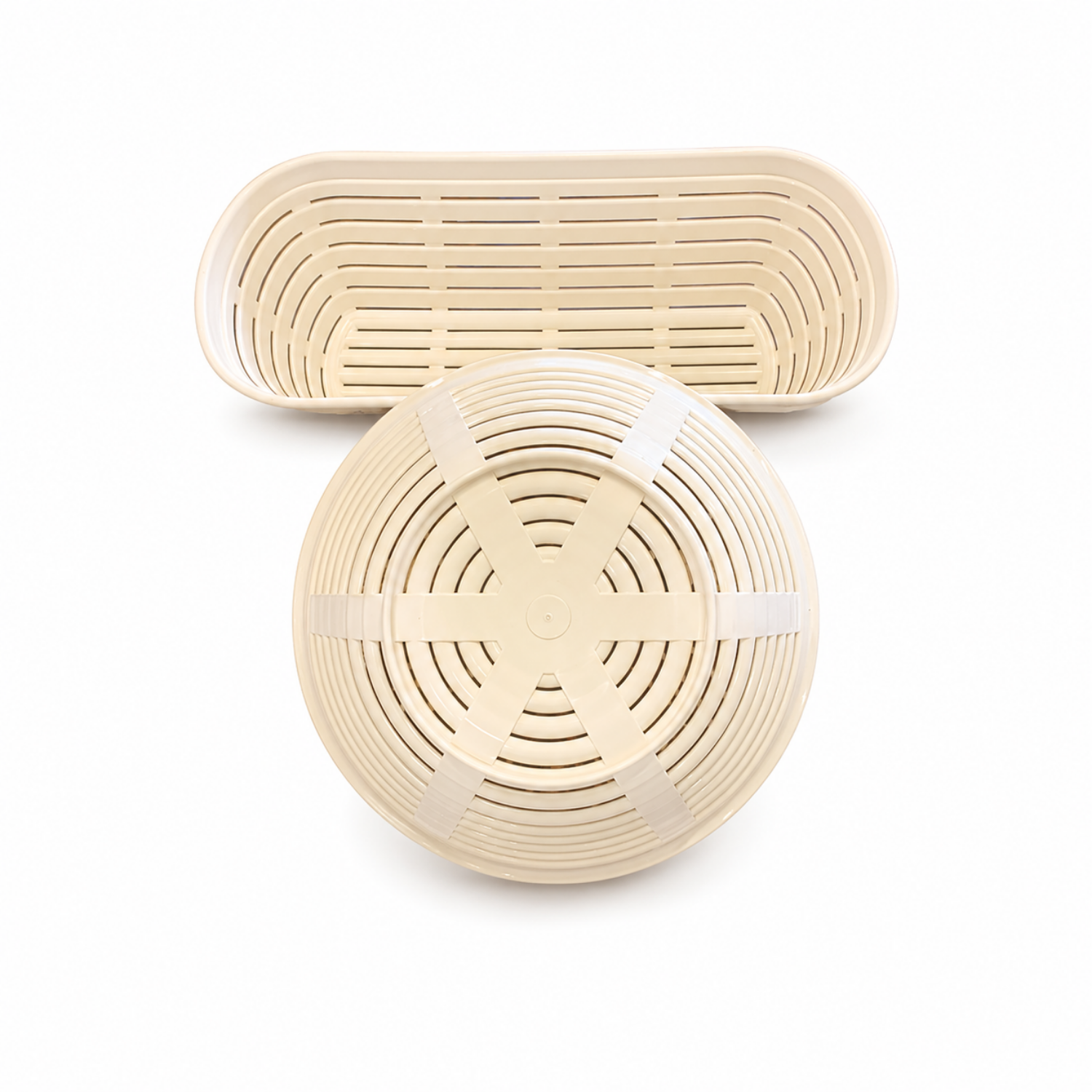
A practical size reference for Australian-made plastic bannetons
Bread Basket Company publishes the following approximate capacities for its Australian-made range. These are useful model-specific starting points, not a formula that can be applied to every cane, wood-pulp or plastic banneton.
| Basket | Manufacturer’s suggested dough weight | Dimensions |
|---|---|---|
| Round, standard | Approximately 600 g–1 kg | 20 cm diameter × 8 cm deep |
| Oval, standard | Approximately 600 g–1 kg | 30 × 13.5 × 7.5 cm |
| Oval, large | Approximately 1–1.6 kg | 34.5 × 16 × 8.5 cm |
The sizes above come from the Bread Basket Company specifications. The manufacturer also identifies its baskets as food-grade polypropylene and dishwasher-safe; follow the care instructions for your particular product rather than assuming all bannetons can be washed the same way.
Other bakers may recommend different weight ranges for similar nominal dimensions. For example, Maurizio Leo’s proofing guide at The Perfect Loaf gives basket recommendations for specific doughs and shapes. That is not a contradiction: capacity depends on the basket’s actual geometry and on how a particular dough behaves.
Why dough strength changes the fit
Two pieces of dough can weigh the same and occupy the basket differently. A well-developed, carefully shaped dough may hold a compact form; a weaker or more extensively fermented dough may relax outward. Hydration, flour, inclusions, fermentation and shaping all change how the dough sits during the final prove.
This is why I would not use a rigid rule such as ‘the basket must be half full’. Look at the shape and the room available for expansion. A basket should support the loaf without forcing it into an unsuitable shape. It cannot repair dough that has lost its structure.
If your dough regularly spreads or sticks when you turn it out, read Why Sourdough Sticks to a Banneton. That is a separate dough-handling problem; buying a larger basket is not necessarily the answer.
Four checks before buying another basket
- Confirm your standard dough portion. Record the weight after dividing, before final proving. For a bakery, use the portion you actually sell rather than the weight of an occasional experimental loaf.
- Check the intended shape. A boule belongs in a round basket; a bâtard belongs in an oval basket. Choose the loaf before the container.
- Measure the baking space. Check the length, width and loading clearance of your tray, stone, pot or oven. The loaf expands during baking, so basket dimensions are not the finished loaf dimensions.
- Check the manufacturer’s own range. Capacity labels are approximate. Confirm the model, material, liner options and cleaning instructions, particularly when ordering multiple baskets.
The microbakery lesson: standardise before you multiply
If you are producing the same bread repeatedly, standardising the dough portion and basket shape reduces unnecessary variation. It makes dividing, shaping, proving, storage and loading easier to organise. It also helps you identify whether a problem comes from the dough or from inconsistent equipment.
Do not buy a dozen baskets merely because they stack neatly. First establish that one basket size works with your dough, fridge space and oven. Then decide how many your production schedule actually needs. My own microbakery experience taught me that increasing the number of tools does not automatically increase useful output.
A simple comparison for your next bake
If you already own two different baskets, divide a single batch into two equal-weight pieces and shape them as consistently as possible. Keep fermentation conditions comparable, then observe how each loaf fits the basket and how it releases. Record the basket model, dough weight and result. This is a suggested trial, not a test I am claiming to have conducted or a guaranteed outcome.
If both baskets are unsuitable, do not force the dough. Adjust the equipment choice or the loaf specification deliberately. The goal is repeatability, not a perfect photograph.
Choose the basket around the bread
For the Australian-made round, standard oval and large oval options discussed here, see the SA Bakery Supplies banneton guide. Check the model and capacity before ordering. A basket is only useful when it suits the loaf you want to make.
For more practical sourdough technique and honest microbakery lessons, join the Baking Journal.
Sources and further reading
- Bread Basket Company — FAQs and basket dimensions (manufacturer specifications and care).
- The Perfect Loaf — The Ultimate Guide to Proofing Bread Dough (basket choice, dough weights and proving considerations).
- The Perfect Loaf — How to Shape a Boule (round basket examples and shaping).


Leave a Reply