
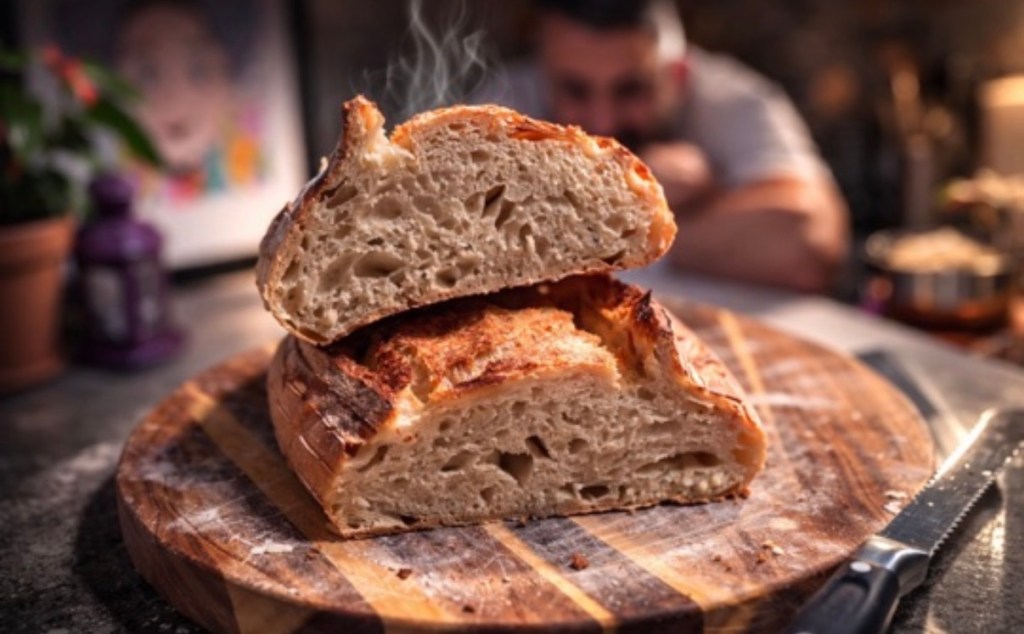
You can follow the same sourdough recipe, use the same flour and bake in the same oven — yet produce two very different loaves. One rises proudly, opens along the score and has a light, balanced crumb. The other spreads, tastes sharply acidic or comes out denser than expected.
Sometimes the difference starts before you mix the dough: the condition of your sourdough starter. It does more than make bread rise. It brings living yeast, lactic acid bacteria and fermentation by-products into the dough, shaping how that dough develops and what the finished loaf tastes and feels like.
This article is about the result in the bread, not simply how to recognise a ripe starter. If you need the basics first, read Your Sourdough Starter Is Not a Clock.
1. Your starter controls more than fermentation speed
A sourdough starter is an active culture. Yeasts generate carbon dioxide that helps expand the dough. Lactic acid bacteria contribute organic acids and flavour compounds. Together with the flour’s own enzymes, they change the environment in which gluten develops and fermentation continues.
That means the starter influences four things that matter when the bread comes out of the oven: how reliably the dough rises, how well it holds that gas, the character of the crumb and the balance of flavour. But it is not the only variable: flour strength, dough temperature, hydration, mixing, bulk fermentation, proofing and baking still matter.
2. The same starter, three different stages
Consider what happens when you use the same culture at different points after feeding. These are typical tendencies, not guarantees; the flour, hydration, temperature and starter’s history all affect the outcome.
| Starter at mixing | Likely effect in the dough | Possible effect on the finished loaf |
|---|---|---|
| Very young / under-ripe — rising but not yet vigorous | Less leavening activity available initially; fermentation may take longer. | If baked before it has fermented enough: lower volume, tighter crumb and a relatively mild flavour. |
| Ripe / vigorous — active, near its usual high point | Strong, predictable fermentation with a moderate level of accumulated acidity. | Good potential for oven spring, an aerated crumb and balanced sourdough flavour — provided proofing and dough strength are right. |
| Well past peak — fallen, highly acidic or exhausted | More acid enters the dough; fermentation performance can be less predictable, and prolonged acidification may weaken wheat dough structure. | A tangier loaf is possible, but the dough may be slacker and less able to retain gas, giving less height or a tighter crumb. |
Important: past-peak starter is not automatically unusable. A healthy culture can often still raise bread. The point is that you are introducing a different balance of leavening activity and acidity into the formula.
From my bakery: two problems that start with the starter
There are two lessons I learned the practical way. First, if your starter is not ready, your bread will not be ready. When a starter has not been fed well enough and is barely active, the whole process can slow down. Dough that should be progressing through bulk fermentation is still waiting for the culture to do its job. In a working bakery, that means the production schedule starts slipping too — not just the bread’s rise.
The 30% rye dough I could not shape
In my microbakery I use a consistent flour approach for different loaves: 70% white wheat flour and 30% of the character flour or blend. For my wholemeal loaf, that 30% is wholemeal; for my rye loaf, it is rye; and for multigrain, it is my multigrain mix. The following mistake happened with my 30% rye sourdough, not a 100% rye bread.
I had fed my starter the night before and there was enough left for another batch. I got a little lazy and skipped the refresh I should have done before making the rye dough. By the time I used it, the starter had become much too sour for the process I wanted.
The dough simply did not behave the way it should. It was so difficult to handle and had so little usable structure that I could not shape it properly. It was not good enough to go into the oven. The balance between the starter’s acidity, its fermenting power and the dough’s ability to hold together was not where it needed to be. Having enough starter by weight had not meant having the right starter for the job.
What went wrong with the dough? Because this formula contained 70% wheat flour, the wheat gluten network was an important source of its elasticity and strength. Rye changes water absorption and dough handling, but this was not the same structural situation as a predominantly rye loaf. An overly mature, strongly acidic starter can contribute to weaker dough handling, particularly when acidification and protein breakdown continue over time. I cannot prove acidity was the only cause of that batch’s failure — total fermentation, temperature and dough development matter as well — but I know the starter was too far gone for my usual method and the dough had lost the structure I needed to shape it.
The bakery lesson: using yesterday’s starter simply because there is enough of it can cost you the entire batch. The 30% rye loaf reminded me to judge the condition of my starter before I judge its quantity.
In a bakery, enough starter is not the same thing as a starter that is ready.
3. Why the starter changes your crumb and oven spring
Gas production is only half the story. Your dough also needs enough strength to retain that gas. A vigorous starter helps fermentation progress, but an over-acidified dough can become increasingly extensible or slack as acidification and protein-degrading enzymes affect its gluten network during a long fermentation.
This is why a starter with plenty of bubbles does not automatically produce big holes in the bread. An open, even crumb depends on the starter and proper dough development, bulk fermentation, shaping and final proofing. Too little fermentation can leave a dense loaf; too much can produce a weakened dough that collapses or spreads.
The best starter is not the one that looks most dramatic in the jar. It is the one that gives your dough the fermentation and structure you want.
4. Why the same flour can produce a different flavour
The longer a starter ferments after feeding, the more its acidity and flavour profile may change. A recently ripe starter often supports a milder loaf; a more mature, acidic levain may contribute a stronger tang. But sourness is not controlled by starter age alone.
The amount of starter used, the percentage of pre-fermented flour, the flour itself, dough temperature, total fermentation time and cold-proof duration all influence the final flavour. More starter does not simply mean more sour bread: a higher inoculation can also shorten fermentation, reducing the time available for acidity to develop.
Think of flavour as the result of an entire fermentation process. The starter sets the direction; the bulk and proof determine much of the journey.
5. Five starter decisions that change your results
- When you use it: a young, ripe or well-past-peak levain brings a different balance of fermentation activity and acidity.
- How regularly you refresh it: consistent feeds help you understand the culture’s normal behaviour and repeat your results.
- Which flour you feed it: wholegrain and rye can change nutrient availability, buffering capacity and fermentation behaviour compared with refined white flour.
- Its hydration and temperature: both influence fermentation rate and microbial activity; there is no universal number of hours to peak.
- How much goes into the dough: starter percentage changes fermentation speed and the amount of pre-fermented flour and acid carried into your mix.
For example, 100 g of starter at 100% hydration contains roughly 50 g flour and 50 g water. Those amounts belong in the total dough formula. Accurate weighing helps ensure a starter experiment does not accidentally become a hydration experiment.
6. Try this: bake the same formula with three starter maturities
If you want to understand what your culture contributes, test it rather than guessing. Build three small levains from the same healthy mother starter using the same flour, water, hydration and feed ratio. Stagger their feeding times so that, at dough-mixing time, one is clearly young, one is near its normal ripe stage and one is just beginning to recede.
Mix three small doughs with the same total flour, water, salt and levain weight. Keep their starting dough temperatures as close as possible. Then follow each dough by its fermentation development, not an identical clock time; different levains may need different lengths of bulk and proof.
- Record the levain’s rise, aroma and stage when it is added.
- Observe how quickly each dough expands and how it feels during folds and shaping.
- Compare how well each shaped loaf holds its form and opens in the oven.
- Once cool, photograph the crumb and taste for acidity, sweetness and overall balance.
- Repeat the comparison before deciding the result was caused by the starter rather than a one-off difference in handling or proofing.
If one loaf is dense, do not automatically blame the starter: check whether it was simply under-fermented. If one spreads, check dough strength and proofing as well as acidity. The goal is to find a repeatable cause, not to win a competition for the biggest holes.
7. What I would change first when a loaf disappoints
- Slow rise and tight crumb: before increasing starter quantity, check that the culture reliably grows after feeding and that the dough has reached an appropriate stage of bulk fermentation.
- Very sour, slack dough: try a fresher, less acidic levain and review total fermentation time and dough temperature.
- Good rise but little tang: experiment with flavour development during fermentation or proofing rather than simply adding more starter.
- Inconsistent results: keep the flour, feeding ratio, levain maturity and dough temperature consistent for several bakes so you can see what actually changes.
The final loaf starts before the mixing bowl
A good sourdough culture is not a magic ingredient, and no single feeding schedule works in every bakery. What matters is using it deliberately. A starter that is vigorous but excessively young, one that is comfortably ripe and one that is heavily acidified will not always lead to the same bread — even with an otherwise identical formula.
Learn how your culture behaves, decide which kind of loaf you want and build a process that produces it consistently. That is the difference between following a sourdough recipe and understanding sourdough.
Want to see the baking process in action? Watch I Baked My Best Sourdough Bread on Healthy Nasti Kitchen. For more practical notes on fermentation and microbakery systems, join the free Baking Journal.
For more background on how rye behaves differently from wheat dough, see King Arthur Baking — Baking with rye flour. Remember that a 30% rye and 70% wheat formula still relies substantially on wheat gluten for dough strength.


Leave a Reply